
AI Content Automation: How To Build a Content Automation System?

Updated: Jan 27
B2B teams are under pressure to deliver more content with less budget—and AI is finally closing that gap. In fact, B2B marketers report growing investment in AI for content creation and optimization in 2025, with 39–40% planning increases according to the latest Content Marketing Institute research.
Tight budgets, complex stakeholder reviews, and multi-channel calendars make manual production too slow. An AI-powered system shifts your team from ad‑hoc writing to governed workflows that generate on-brief assets at speed.
You’ll learn how to define success, design a workflow, set brand guardrails, and operationalize SEO and repurposing—so you scale output without sacrificing quality.
Build this once, and publishing becomes predictable. That’s how you cut time-to-publish while improving consistency.
What Is AI Content Automation?
AI content automation is a governed system that turns structured inputs into on-brand assets across channels. It combines prompts, templates, data, and approvals to generate drafts, variants, and metadata on demand.
For B2B teams, the payoffs are faster cycles, consistent voice, and measurable impact on pipeline.
You’re not replacing strategy—you’re codifying it. AI becomes your production layer while humans own narrative, POV, and sign‑off.
That strategy should be rooted in revenue outcomes first—this marketing and content strategy that drives revenue explains how to align content to pipeline before automating anything.
Set the expectation early: automation accelerates work you’ve already defined—it doesn’t invent your strategy.
Define Success: Business Goals, KPIs, and Governance for Scalable Content Production
Start with revenue-linked goals before you touch a model. Tie SEO pages, blog series, and nurture sequences to MQLs, SALs, and pipeline contribution. When outcomes are clear, prompts and templates align to business impact.
If you haven’t mapped content to funnel stages and attribution yet, start with a clear revenue-driven marketing and content strategy before scaling production.
Lock definitions with sales to avoid scoring confusion. If your team uses MQLs, align on behaviors and thresholds, then track lifts by channel. Use a shared definition and examples like the ones in HubSpot’s MQL guide.
Create a lightweight governance memo: decision rights, approval SLAs, compliance notes, and escalation paths. The result is scalable content production for B2B demand generation you can defend in QBRs.
Map Your Marketing Workflow: From Brief to Publish to Repurpose
Document your real process—from intake to analytics—to find automation wins. List every status, handoff, and approval. Identify bottlenecks: legal review, SME sign-off, or CMS formatting. Then map each step to a tool or template so nothing depends on memory.
Use a standard workflow language your team already understands. A clear swimlane with states like Brief → Draft → Edit → Approve → Publish → Repurpose mirrors best practices outlined by Atlassian’s workflow management overview.
Add one more lane for “Repurpose.” When a piece goes live, automation should kick off micro‑assets without another meeting. That’s marketing workflow automation for content teams that scales.

Build Your Brand Voice System: Style Guides, Guardrails, and Compliance
Codify your brand voice so AI can follow it. Write 6–10 voice rules with short examples, common do/don’t phrases, and formatting quirks. Include audience nuances by segment or industry.
Reference a public model like the Mailchimp Content Style Guide to structure sections: voice and tone, grammar and mechanics, web elements, and accessibility. Then translate those parts into programmable checks inside your prompts.
Add compliance guardrails: risky claims to avoid, required disclaimers, and attribution rules. The output: brand voice governance baked into generation, not bolted on later.
Create Reusable Inputs: Brief Templates, Prompts, and Data Sources
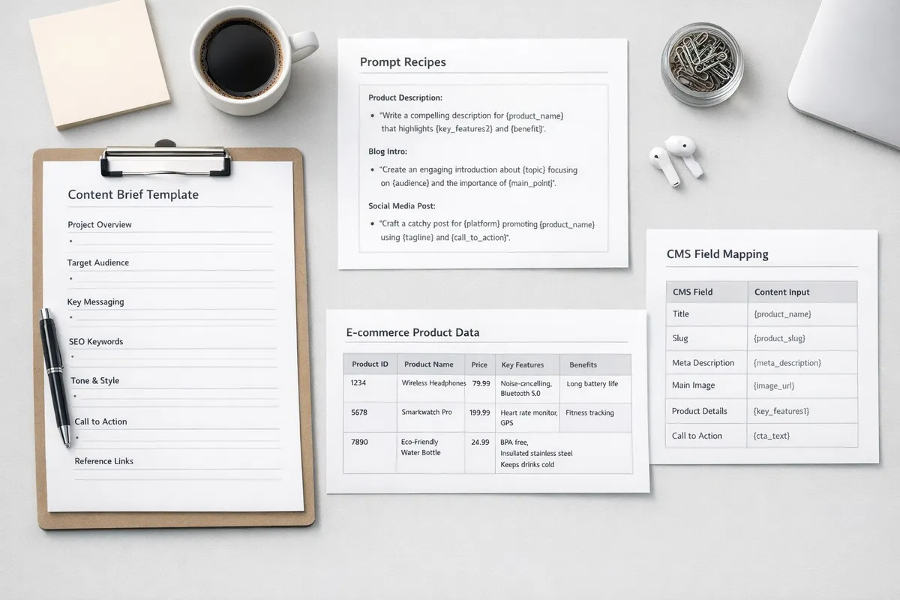
Reusable inputs are the fuel your system runs on. Standardize creative briefs (goal, audience, angle, CTA), SERP notes (intent, entities, gaps), and product facts (benefits, proof points, compliance lines).
Capture prompt patterns that work and store them as “recipes” with variables. Improve over time using official guidance like OpenAI’s prompt engineering best practices.
Feed your models with trusted data: ICP notes, case-study quotes, and SME answers. When inputs are consistent, outputs become reliably on-brief across channels.
AI Content Automation for SEO: Research, Outlines, Drafts, and Internal Links
Treat SEO as a repeatable factory line, not a heroic effort. Automate keyword clustering, SERP intent analysis, and outline generation. Then draft with entity coverage and on‑page structure (H1/H2s, schema, alt text).
Use Google’s fundamentals as your north star; the SEO Starter Guide clarifies what matters—from crawlability to helpful content.
For internal links, predefine anchor text patterns for each product pillar so your automation inserts contextually relevant links.
Measure what ships: rank movement, clicks, assisted conversions, and content velocity. That’s how AI content automation for SEO becomes a pipeline lever, not just a traffic play.
Internal Linking Mini-Blueprint
Create a per‑pillar anchor list, add 2–3 contextual links per post, and refresh older articles weekly to point toward new assets. Keep anchors descriptive and human.
Content Repurposing Automation: Turn Webinars, Blogs, and Reports into Multi-Channel Assets
Repurposing multiplies reach without multiplying headcount. Convert long-form assets into email drips, social threads, short videos, and sales one‑pagers—programmatically.
Use a “core asset → derivatives” map and apply channel-specific guardrails for length, tone, and CTA.
Automate the first draft of each derivative, then assign human review. That’s content repurposing automation you can schedule and measure.

Quality Assurance: Human-in-the-loop Editing, Fact-Checking, and Bias Controls
Human review is non‑negotiable for accuracy and trust. Set a two‑stage edit: language/voice first, then fact/compliance. Capture corrections and feed them back into prompts and knowledge bases.
Adopt a recognized fact‑checking standard to keep outputs credible. The International Fact‑Checking Network’s principles are a solid reference point for policy and training (IFCN Code of Principles).
Use bias checks and sensitive-topic flags. Over time, your QA notes become reusable instructions—quality improves as velocity increases.
Pilot to Rollout: Blueprint, Milestones, and Change Management for Your Team
Pilot small, win fast, then expand with confidence. Pick one workflow—like SEO blogs for a single product line—define success, and ship 10 assets. Compare speed, quality, and results against a baseline.
Use a proven change model like Prosci’s ADKAR to guide adoption: build Awareness/Desire with demos, train for Knowledge/Ability, and Reinforce with recognition and dashboards.
Roll out to email and social last, once your brand voice system is stable. That keeps momentum high while reducing adoption risk.

Cost and ROI Modeling: Throughput, Savings, and Capacity Planning
Model ROI using cycle time, cost per asset, and revenue impact. Start with your current baseline (hours and dollars per post), then forecast lifts in output and reductions in edits. Sanity-check with a simple ROI formula as outlined by Investopedia.
Run two scenarios: conservative (20% faster) and aggressive (50% faster). Add quality gates so you don’t trade accuracy for speed. The result is a plan finance can trust and a capacity forecast you can staff against.
When your system is humming, A/B testing velocity becomes a competitive moat.
> Want a quick ROI snapshot? Estimate current hours per post × hourly rate vs. automated hours, then multiply time saved by your monthly volume.
Real-World Use Cases: SEO Content Automation and Nurture Sequence Acceleration
SEO factory for product pillars. Define 3–5 pillars, automate briefs from SERP gaps, and publish two posts per pillar per month. Refresh older content weekly with new internal links.
Nurture at speed without losing voice. Turn a webinar into a 5‑email sequence with segment‑specific intros and CTAs. Use your brand voice system to keep tone steady while variants personalize.
For industry‑wide adoption context, see Salesforce’s 9th edition State of Marketing insights on AI in marketing operations.
With a governed stack, throughput rises while review cycles shrink.
Common Pitfalls and How to Avoid Them in AI Content Automation
Pitfall: off‑brand or non‑compliant claims. Fix with stricter guardrails and mandatory human review. Maintain a “claims library” with approved language and required disclosures.
Pitfall: hallucinations or dated facts. Mitigate with retrieval from trusted sources and a fact‑checking checklist. NIST’s AI Risk Management Framework provides a structured lens for governance (NIST AI RMF 1.0).
Document misses, roll them back into prompts, and treat errors as training data, not one-off issues.
Implementation Checklist and Next Steps
Use this one-page checklist to go from idea to first publish.
● Brief template finalized (goal, audience, POV, proof, CTA)
● Brand voice rules and compliance lines codified in prompts
● SEO pipeline mapped (cluster → outline → draft → on‑page → links)
● Repurposing map created for your core asset types
● QA: editor/fact-checker assigned with SLAs
● Pilot metrics: cycle time, edits per draft, acceptance rate, traffic/MQLs
● Change plan with champions, training, and reinforcement
● RACI defined for each stage (see Atlassian’s RACI overview: RACI chart guide)
FAQs
Can AI produce on-brand content without constant rewrites? Yes—if you codify voice, tone, and compliance as reusable rules. Teams that front‑load guardrails see far fewer edits and faster approvals across channels.
Will AI content automation hurt our SEO quality? No—when you align to search intent and entity coverage, human‑edit for clarity, and maintain clean internal links. Quality rises as you standardize outlines and refresh cycles.
How do I start without disrupting current campaigns? Pilot one workflow (e.g., a single product pillar) for 30 days. Compare cycle time, acceptance rate, and traffic to your baseline, then expand in phases.
What tools do I need to integrate first? Start with your CMS, MA/CRM, and a shared content OS for briefs/prompts. Add analytics and QA checklists next; connect everything to your brand voice rules.
Wrap-Up: Your Path to Scalable Content Production
AI content automation turns your strategy into a repeatable, governed system. When goals, voice, and workflows are clear, you can publish faster without losing accuracy. The result is scalable content production that supports pipeline, not just pageviews.
Start small, measure hard, and expand with confidence. If you want an end‑to‑end system that respects brand voice and SEO fundamentals, explore HypeSuite AI as a practical co‑pilot for your team.
Your next publish cycle can be smoother—and your calendar more ambitious—starting today.


Comments