
11 Best AI SEO Tools in 2026 (Tested & Ranked)

Updated: Aug 7
If you're a SaaS founder or content marketer trying to grow organic traffic without a full agency behind you, you've probably asked some version of this: "Which AI SEO tool is actually worth it?"
The short answer is — it depends on what your content workflow looks like today. Some tools help you write faster, others help you rank smarter, and a few are starting to do both.
In this guide, you'll find the top AI SEO tools across every use case and budget, a plain-English explanation of what each one actually does, a comparison chart, and a framework for picking the right one for your team.
We've also included specific recommendations for SaaS, e-commerce, and local businesses so you can skip the generic advice.
For more on how AI is transforming search optimization beyond tools — including content systems, SERP analysis, and E-E-A-T — see our full AI SEO resource hub.
What AI SEO Tools Actually Do (And Why It Matters Now)
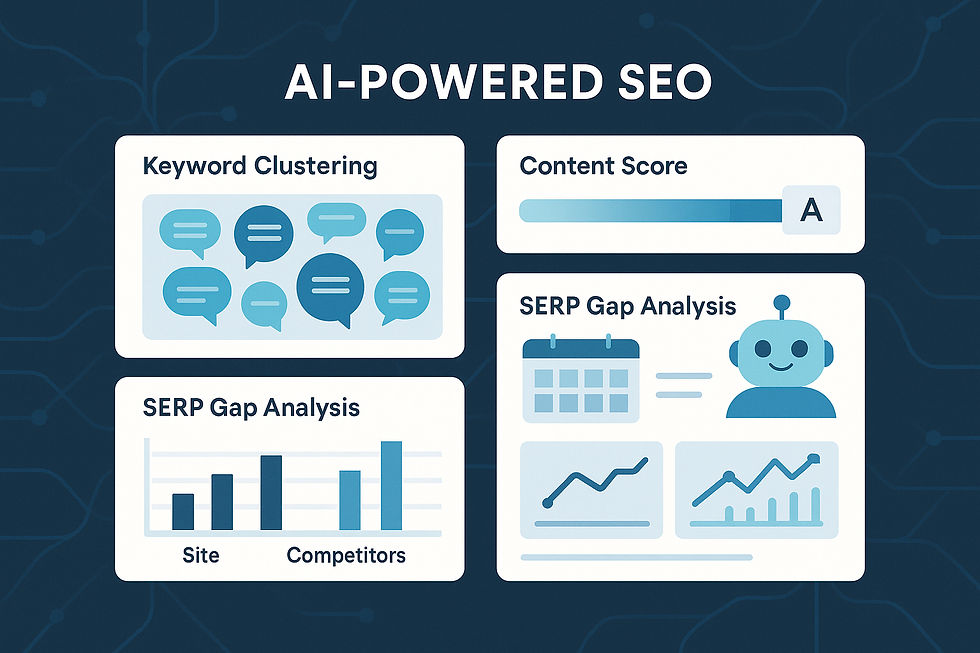
AI SEO tools use machine learning and natural language processing to handle tasks that used to require an SEO specialist, a content strategist, and a copywriter working in tandem. They don't just surface data, they interpret it, suggest actions, and increasingly take those actions for you.
In 2026, the stakes are higher than they were a few years ago. Google's AI Overviews now appear at the top of results for a wide range of queries, which means your content doesn't just compete for a blue link, it competes to be cited inside an AI-generated answer. The tools worth investing in are the ones that understand this shift.
Here's what the best AI SEO tools can help you with:
Keyword clustering by intent — grouping related keywords so each piece of content targets a coherent topic rather than a single phrase
Content scoring and NLP optimization — analyzing top-ranking pages and recommending the terms, structure, and depth your content needs to compete
SERP and competitor analysis — understanding what the top 10 results actually do well, and where the gaps are
Technical SEO automation — bulk-editing meta tags, identifying crawl issues, generating alt text, and flagging broken links at scale
AI visibility tracking — monitoring whether your content appears in AI-generated answers from Google, ChatGPT, and Perplexity
For a lean team or solo operator, the right combination of these capabilities can replace thousands of dollars a month in agency fees — but only if you pick tools that match your actual workflow.
How to Choose the Right AI SEO Tool Before You Buy
Before diving into the list, it's worth taking five minutes to figure out where you actually are. The most common mistake marketers make is buying a powerful tool and using 15% of it.
Ask yourself three questions:
1. What's your biggest bottleneck right now? If you can't produce enough content, you need a writing-first tool (Jasper, Frase, Scalenut). If you're publishing content but it's not ranking, you need an optimization tool (SurferSEO, Clearscope). If you're ranking but not appearing in AI answers, you need a visibility tracker (SE Ranking's AI Overview Tracker, Wellows).
2. What does your team look like? Solo founder with no writers: look for tools with AI generation baked in. Small team with a writer: look for tools that speed up research and briefs. Agency or content-heavy team: look for tools with collaboration, SOPs, and audit features.
3. What's your monthly content budget? Under $50: Frase ($15), Scalenut ($39), GrowthBar ($36) $50–$150: SurferSEO ($99), Jasper ($49+), Outranking ($79) $150+: Clearscope ($170), MarketMuse ($149), Alli AI ($249)
Pro tip: Most tools offer a free trial. Run a real piece of content — not a test topic — through any tool before committing. The gap between what a tool promises and what it delivers in your niche is only visible when you use it on your actual work.
The 11 Best AI SEO Tools in 2026
1. HypeSuite AI — Best All-in-One SEO Agent for Founders and Lean Teams
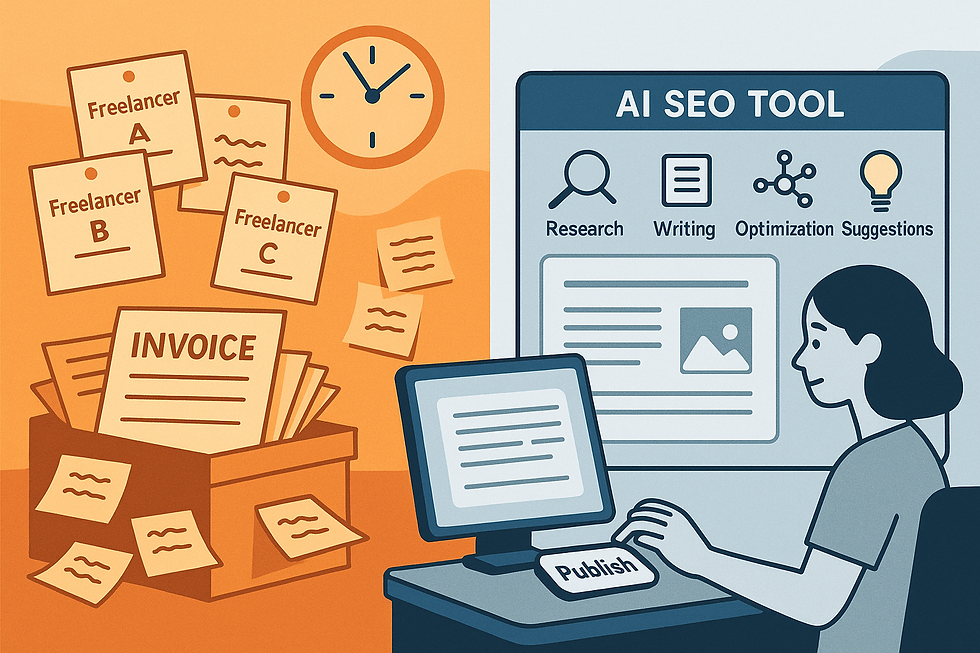
Most AI SEO tools make you do the thinking and just help you execute faster. HypeSuite AI works differently — it acts as a full SEO agent that handles the entire content workflow from start to published post, without requiring you to coordinate between five different tools or manage a freelancer pipeline.
The workflow is deliberately simple: enter a keyword, choose your target persona, and HypeSuite produces a complete, ready-to-publish blog post — structured to Google's E-E-A-T standards, paired with keyword-optimized images and alt text, and ready to push directly to your CMS. The average time from keyword to complete blog is 7.3 minutes. That's not a draft — that's a finished, SEO-ready piece with visuals, internal links, metadata, and schema markup included.
What makes HypeSuite meaningfully different from tools like Jasper or SurferSEO is that it was built by marketers who understood that the bottleneck isn't writing speed — it's the ten decisions you have to make before and after writing. HypeSuite eliminates those by baking in SERP research, brand voice calibration, image generation, and CMS publishing into a single flow. You're not stitching together a stack. You're running one tool.
How it works, step by step:
Brand & voice setup — HypeSuite builds a full profile of your company, audience, and tone before it writes a single word, so content sounds like you, not a generic AI
SERP & intent research — it analyzes the top-ranking results for your keyword to understand what searchers actually want, then structures the article around those signals
E-E-A-T writing engine — produces well-sourced, well-structured content that reflects experience and expertise, written for humans first and optimized for search engines second
Smart visual generation — creates relevant paragraph-level images, names the files using your target keywords, and writes descriptive alt text automatically
One-click publishing — pushes the finished post directly to WordPress, Wix, or Netlify with no copy-paste required
Real usage numbers from early users:
78% of users generated 3 or more complete blogs in their first week
Each blog includes at least 5 automatically generated, keyword-optimized images
Average time to a fully complete, publish-ready blog: 7.3 minutes
Key features:
Complete SEO blog generation from a single keyword input
Brand voice and persona customization built into every piece
SERP and search intent analysis before writing begins
E-E-A-T compliant content structure, automatically applied
AI-generated images with keyword file names and auto alt text
One-click publishing to WordPress, Wix, and Netlify
Supports 30+ languages
Free SEO checker tool included at seochecker.hypesuite.ai
Best for: SaaS founders, freelancers, small agencies, and content marketers who want to publish consistent, high-quality SEO content without building a complex toolstack or managing writers. Especially strong for teams publishing in multiple languages or across multiple client sites.
Pricing: Free trial available — start your first blog for free at app.hypesuite.ai.
The honest trade-off: HypeSuite is optimized for producing complete, rankable blog content efficiently. If you need deep backlink analysis, rank tracking dashboards, or technical site auditing, you'll want to pair it with a dedicated SEO platform. For content production specifically, it's the fastest path from keyword to published post available today.
2. SurferSEO — Best for Data-Backed Content Optimization
SurferSEO is the closest thing to an industry standard for content optimization. Its Content Editor scans top-ranking pages in real time and tells you exactly what terms to include, how long your piece should be, and how many headings and images top competitors are using. In practice, this means you're not guessing — you're working from SERP data every time you write.
The tool's NLP scoring has become a benchmark for the category. A test on a competitive keyword like "organic bedding" surfaced missing terms like "GOTS certified" and flagged that top-performing pages used shorter introductions — details that matter when the difference between position 4 and position 1 is subtle.
Key features:
Real-time Content Editor with NLP scoring
Keyword clustering by search intent
Topical Map for building subject authority
AI Overviews and traditional SERP tracking
Integrations with Jasper, Google Docs, WordPress
Best for: SaaS content teams publishing 4+ pieces per month who want data-backed optimization without hiring an SEO agency.
Pricing: Starts at $99/month. AI writing features require a separate add-on.
Watch out for: Following every suggestion too rigidly can produce over-optimized content that reads like an SEO checklist. Use it as a guide, not a script.
3. Clearscope — Best for Editorial Quality at Scale
Clearscope is the tool editors love. Its content grading system is widely regarded as among the most accurate in the category, and its Google Docs integration makes it frictionless to use inside an existing writing workflow. Rather than overwhelming writers with suggestions, it surfaces the most relevant semantic keywords ranked by importance — clean, actionable, and fast to act on.
Key features:
AI-powered content grading (A+ to D)
Real-time competitor content analysis
Google Docs and WordPress integrations
Keyword discovery and reporting
Best for: Editorial teams that already have strong writers and want to make every piece more competitive without adding complexity.
Pricing: Starts at $170/month. Pricey for small teams, but the accuracy and support justify it at scale.
4. Frase — Best for Research and Brief Creation
Frase sits at the intersection of research tool and AI writer. Where SurferSEO focuses on optimization, Frase focuses on understanding a topic before you write about it. Its AI Writer analyzes top-ranking SERP results for your target keyword, builds a content outline from those insights, and then generates a draft that reflects the actual competitive landscape — not a generic AI template.
Frase is also one of the few tools adding GEO (generative engine optimization) features, helping you optimize for AI-generated answers, though this capability is still in beta.
Key features:
Automated content briefs from SERP analysis
AI writing assistant with tone and brand voice settings
Meta title and description generators
Google Search Console integration for tracking
Answer engine for topic discovery
Best for: Freelancers, solo marketers, and small teams that need to go from keyword to draft quickly without separate tools for research and writing.
Pricing: Starts at $14.99/month — one of the best value tools in the category.
5. Jasper — Best for High-Volume AI Content Generation
Jasper is the most widely used AI writing tool in marketing, and when combined with SurferSEO, it becomes one of the fastest ways to produce SEO-optimized long-form content. Powered by GPT-4o, it handles everything from blog intros to full-length posts, product descriptions, and email sequences — all within a polished, easy-to-use interface.
The key caveat: Jasper produces first drafts that need human editing for nuance, brand voice, and accuracy. Teams that treat it as a replacement for editorial judgment tend to produce forgettable content. Teams that treat it as a first-draft engine — then edit thoroughly — save enormous amounts of time.
Key features:
Long-form blog writing templates
GPT-4o-powered content generation
SurferSEO content score embedding
Brand voice customization
50+ writing templates
Best for: SaaS marketers who need to produce large volumes of content and have the editorial capacity to review and refine outputs.
Pricing: Starts at $49/month.
6. Outranking — Best for SOP-Based Content Workflows
Outranking takes a systematic approach to SEO content — ideal for teams that want a repeatable process rather than a blank-page tool. It walks you from research to brief to draft to optimization inside a single flow, and its audit mode makes it straightforward to refresh older content based on current SERP trends.
Key features:
Research, brief, write, optimize in one workflow
AI outlines and automatic meta generation
Content audit mode for existing pages
Team collaboration features
Best for: Growing content teams or agencies transitioning away from fragmented
toolstacks.
Pricing: Starts at $79/month.
7. Scalenut — Best Affordable All-in-One Option
Scalenut packs a keyword planner, NLP topic model, and AI writing assistant into one of the lowest price points in the category. Its "Cruise Mode" generates a full article from a single keyword, making it appealing for founders and small teams that need content quickly without a steep learning curve.
Key features:
Keyword planner with NLP topic modeling
Cruise Mode for full article generation
AI writing assistant with SERP-backed briefs
Content optimizer with competitive scoring
Best for: Budget-conscious founders and early-stage teams who need an end-to-end tool without paying enterprise prices.
Pricing: Starts at $39/month.
8. MarketMuse — Best for Enterprise Content Strategy
MarketMuse is built for large sites and content-heavy teams that need to make strategic decisions at scale. Its predictive content scoring and topic modeling help you prioritize which pages to create, which to update, and which are dragging down your domain authority. The content inventory feature gives you a bird's-eye view of an entire site's SEO health.
Key features:
Content inventory and gap analysis
Predictive content scoring
Topic modeling for authority building
Automated content briefs
Best for: Enterprise marketing teams, large publications, and agencies managing high-volume content operations.
Pricing: Starts at $149/month. Significantly more capable — and more expensive — at higher tiers.
9. GrowthBar — Best for Solo Marketers and Startups
GrowthBar is the most accessible tool on this list. Its one-click blog post generation and built-in SEO audit tools are designed for marketers who want to move fast without a technical background. The Chrome extension makes it easy to analyze any search result on the fly.
Key features:
One-click blog post generation
Built-in keyword research and SEO audit
Chrome extension for real-time SERP insights
Best for: Founders and solo marketers who are new to SEO and want a simple, fast tool without a steep learning curve.
Pricing: Starts at $36/month.
10. NeuronWriter — Best for Multilingual Content
NeuronWriter uses semantic keyword integration and SERP comparison across languages, making it the strongest option for SaaS teams with a global audience. Its NLP content scoring works in multiple languages, and the interface — while somewhat technical — is well-suited to SEOs who want granular control over optimization.
Key features:
Semantic keyword integration
AI content scoring with competitor comparison
Multilingual SERP analysis
NLP writing guidance
Best for: SaaS companies or agencies serving non-English markets, or teams building content in multiple languages simultaneously.
Pricing: Starts at $19/month.
11. Alli AI — Best for Technical SEO Automation
Alli AI operates differently from every other tool on this list. Rather than helping you write better content, it helps you optimize hundreds of existing pages at scale — editing meta tags, H1s, and on-page code changes directly through the browser. For growth-stage SaaS companies with large site backlogs, this can be transformative.
Key features:
Live on-page code edits via browser
Bulk meta title, description, and H1 editing
Auto-optimization suggestions at scale
Schema and structured data automation
Best for: Technical SEOs, large SaaS platforms, and agencies managing clients with hundreds of pages that need optimization.
Pricing: Starts at $249/month. Not for early-stage teams — but for the right use case, it pays for itself quickly.
AI SEO Tools Comparison at a Glance
Tool | Best For | Starting Price | Content Generation | SEO Optimization | Technical SEO |
HypeSuite AI | All-in-one SEO agent | Free trial | ★★★★★ | ★★★★★ | ★★★☆☆ |
SurferSEO | Content optimization | $99/mo | Add-on | ★★★★★ | ★★★☆☆ |
Clearscope | Editorial quality | $170/mo | — | ★★★★★ | ★★☆☆☆ |
Frase | Research & briefs | $14.99/mo | ★★★★☆ | ★★★★☆ | ★★☆☆☆ |
Jasper | AI writing volume | $49/mo | ★★★★★ | ★★★☆☆ | ★☆☆☆☆ |
Outranking | Workflow SOPs | $79/mo | ★★★★☆ | ★★★★☆ | ★★☆☆☆ |
Scalenut | Budget all-in-one | $39/mo | ★★★★☆ | ★★★★☆ | ★★☆☆☆ |
MarketMuse | Enterprise strategy | $149/mo | ★★★☆☆ | ★★★★★ | ★★★☆☆ |
GrowthBar | Beginners & solos | $36/mo | ★★★☆☆ | ★★★☆☆ | ★★☆☆☆ |
NeuronWriter | Multilingual content | $19/mo | ★★★☆☆ | ★★★★☆ | ★★☆☆☆ |
Alli AI | Technical at scale | $249/mo | ★☆☆☆☆ | ★★★☆☆ | ★★★★★ |
Industry-Specific Recommendations
For SaaS Companies
The biggest challenge for SaaS SEO is producing enough topically authoritative content to rank in a competitive space. The strongest starting point is HypeSuite AI — it handles the full workflow from keyword to published post in under 10 minutes, with brand voice, SERP research, and CMS publishing built in.
If you want to layer in deeper optimization on top, add SurferSEO for content scoring. For teams that are very budget-constrained early on, Frase + Scalenut covers most of the same ground for under $60/month combined.
For Dentists and Local Service Businesses
Local SEO has specific nuances — proximity signals, Google Business Profile optimization, and review velocity matter as much as content. For the content side, GrowthBar or NeuronWriter provide enough capability without overwhelming complexity. Pair either with a local citation management tool for best results.
For E-commerce and Product-Led Content
E-commerce SEO requires a mix of product page optimization and informational content to capture buyers at different stages. Alli AI is worth the investment for stores with hundreds of product pages that need technical optimization at scale. For informational content, Frase or SurferSEO handles the brief-to-draft workflow well.
Common Mistakes That Undercut Your Results
Even the best AI SEO tool delivers poor results when misused. Here are the four patterns that consistently cost teams rankings:
Publishing without editing. AI-generated content that goes live unedited tends to be factually thin, tonally flat, and structurally generic. Google's Helpful Content signals are increasingly sensitive to this. Every AI draft needs a human pass for accuracy, brand voice, and original insight.
Optimizing for keywords instead of intent. A high search volume keyword is useless if the searcher's actual goal doesn't align with your product or content angle. Before targeting any keyword, look at the top 10 results and ask: "Would this audience be interested in what we offer?" Tools like Frase make this intent analysis easy to do before you write a single word.
Using only 20% of a tool's features. Most teams spend money on platforms and only use the most obvious feature. SurferSEO's Topical Map, Frase's Answer Engine, and MarketMuse's Content Inventory are all underutilized and genuinely valuable. Set aside an hour after signup to explore every feature — it often changes how you use the tool entirely.
Skipping content refreshes. SEO is not a publish-and-forget workflow. Posts that rank on page 2 can reach page 1 with a targeted update — new data, expanded sections, improved internal links. Tools like Outranking and MarketMuse flag aging content and recommend what to update. Running a quarterly content audit pays compounding dividends over time.
How AI SEO Tools Are Evolving in 2026
The category has shifted significantly in the last 18 months. Three trends are worth paying attention to:
AI visibility tracking is now a core feature. Because Google AI Overviews and ChatGPT are capturing a growing share of informational search traffic, tools like SE Ranking's AI Overview Tracker and Wellows have emerged to help you monitor whether your content is being cited in AI-generated answers. This used to be a niche concern — it's quickly becoming essential.
Generative Engine Optimization (GEO) is a real discipline. As Search Engine Journal has documented, optimizing for AI-generated answers requires slightly different content signals than traditional SEO — more structured, more source-citable, and more likely to include direct definitions and clear factual claims. The tools building GEO features first (Frase, Writesonic) have a head start.
The all-in-one stack is consolidating. The era of stitching together five separate tools is ending. Platforms like HypeSuite AI, Semrush One, and Writesonic Professional are building toward end-to-end workflows where strategy, creation, publishing, and tracking live in one place. For most teams, this is a better trade-off than a best-of-breed stack that requires constant integration maintenance.
Frequently Asked Questions
Are AI SEO tools better than hiring an SEO freelancer?
They're faster, more consistent, and significantly cheaper at scale. A solid tool stack runs $50–$200/month versus $2,000–$5,000/month for a good freelancer or small agency.
The trade-off is that tools don't bring creative strategy, relationship-based link building, or deep industry context the way a skilled human specialist does. Most growing teams end up using both — tools for production, a specialist for strategy.
Do AI SEO tools work for brand new websites?
Yes, with realistic expectations. AI tools help you create optimized content faster, but a new domain still needs to build authority over time. GrowthBar and Frase are good starting points because they're simple and low-cost. Focus on keyword research for SEO targeting low-competition, specific queries while the domain ages.
Can AI tools help me rank in Google's AI Overviews?
Increasingly, yes. Tools like SurferSEO's Topical Map and SE Ranking's AI Overview Tracker help you understand which topics trigger AI Overviews and whether your site is cited.
To improve your chances, create content that is well-structured, factually precise, and covers topics comprehensively — the same signals that earn featured snippets.
What's the difference between a content optimization tool and an AI writing tool?
Content optimization tools (SurferSEO, Clearscope, NeuronWriter) analyze existing SERP data and tell you how to improve content for ranking. AI writing tools (Jasper, GrowthBar, Scalenut) generate draft content from a prompt or keyword.
Many modern tools combine both, but they have different strengths. Optimization tools are more valuable if you already have a writer; writing tools are more valuable if you don't.
How long does it take to see results from AI SEO tools?
Content SEO results typically take 3–6 months to materialize, regardless of which tool you use. AI tools accelerate the inputs — more content, better optimized — but they don't change Google's indexing timeline.
The fastest wins usually come from optimizing existing content that's already ranking on page 2, which can move to page 1 in weeks with targeted improvements.
Is AI-generated content penalized by Google?
No — Google's guidance is that it evaluates content quality and helpfulness regardless of how it was produced.
What it does penalize is low-quality, unhelpful, or manipulative content, whether written by a human or an AI.
The safest approach is to use AI for research, structure, and first drafts, then edit thoroughly for accuracy and original insight before publishing.
Which AI SEO tool is best for a SaaS startup on a tight budget?
Frase at $14.99/month is the strongest value for a content-focused early-stage team. It covers research, briefs, and AI writing in one interface. If you need more optimization depth, add SurferSEO when the budget allows. For a completely automated solution designed specifically for SaaS, HypeSuite AI is built for exactly this use case.
Do I need technical SEO knowledge to use these tools?
Most tools on this list are designed for non-technical marketers and require no coding knowledge. Alli AI is the exception — it edits live site code, which requires at least a basic technical foundation.
Tools like GrowthBar, Frase, and Scalenut are specifically built for people who are new to SEO.
Can AI SEO tools replace a full SEO strategy?
Not entirely. They automate the execution side well — keyword research, content creation, on-page optimization, tracking — but a coherent SEO strategy still requires human judgment about positioning, audience, competitive differentiation, and long-term authority building. Think of AI tools as a force multiplier for strategy, not a replacement for it.
What's the best AI SEO tool for writing blog posts specifically?
For pure writing quality and speed, Jasper is the most capable. For writing that's tightly aligned with SERP data from the start, Frase produces more rankable first drafts because it builds from competitive research rather than a blank slate.
For teams that want to go from keyword to published post with minimal manual steps, HypeSuite AI automates the entire workflow including CMS publishing.


Comments